
Question
- Leaving Cert. Physics (Higher) 2016: Section A Q3
- Back to the question >
Answer
In an experiment to measure the wavelength of monochromatic light, the angles θ between a central bright image (n = 0) and the first and second order images to the left and right were measured. A source of monochromatic light and a diffraction grating of 500 lines per mm were used.
Describe, with the aid of a labelled diagram, how the data were obtained.
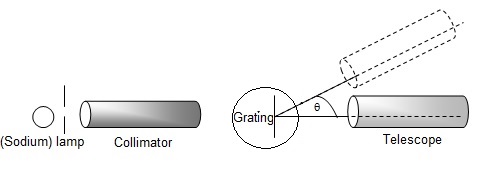
- Adjust the eyepiece of the telescope so that the cross wires are sharply focused.
- Focus the telescope for parallel light using a distant object.
- Set up the apparatus, as shown above. Looking through the telescope, focus the collimator lens and adjust the width of the slit until a clear, narrow image is seen.
- Place the diffraction grating on the turntable at right angles to the beam.
- Move the telescope to the right until the cross wires are centred on the first bright image. Take the reading, θ, from the scale on the turntable. Move the telescope back through the centre and then to the first bright image on the left. Take the reading for this position. The average of the two is the angle, θ for the first order image (n = 1).
- Repeat for the second order images.
The following data were recorded.

Use the data to calculate
(i) the wavelength of the light
(ii) the maximum number of images that could be observed.
(i)

(ii)
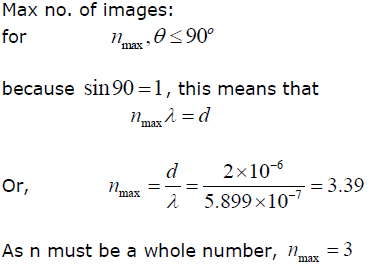
This means that there would be a maximum of 7 images, (3 left, 3 right, 1 centre).
Explain what would happen to the positions of the images if
(i) the wavelength of the light was decreased
(ii) the diffraction grating was replaced with a diffraction grating of 300 lines per mm.
Following the formula nλ = d sinθ, we can say that:
(i) Decreasing the wavelength, λ, also decreases θ. The images would move closer together.
(ii) Replacing the diffraction grating would increase the value of d. This would decrease the value of θ. The images would move closer together.