
Question
- Leaving Cert. Physics (Higher) 2018: Section A Q2
- Back to the question >
Answer

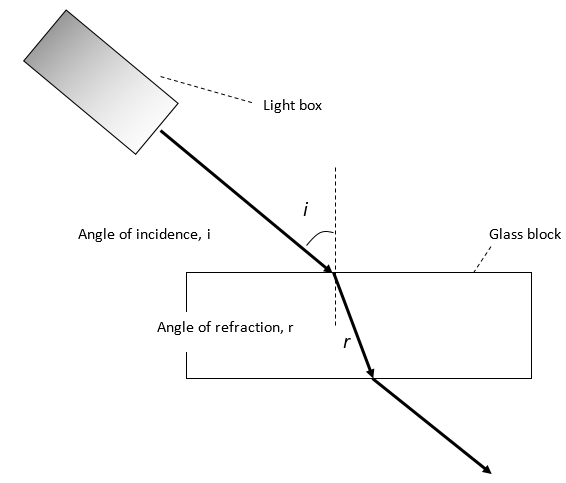
Describe, with the aid of a labelled diagram, how the student determined the angle of refraction.
How to determine the angle of refraction:
- Place a glass block, as shown and mark its outline.
- Shine a ray of light from a light-box, as shown.
- Mark the position of the light ray as it enters and leaves the block, and remove the block.
- Draw in the normals and measure i and r, as shown.
Draw a suitable graph to show the relationship between the angle of incidence and the angle of refraction. State this relationship and explain how your graph verifies it. Use your graph to determine the refractive index of the material used.


Snell’s Law tells us that the sin of the angle of incidence (sin i) is directly proportional to the sin of the angle of refraction (sin r). This is verified here by the straight line through the origin.
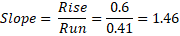
As the refractive index is given by the slope of the line, we can say that the refractive index is this case is 1.46.
What would be observed if the incident ray was perpendicular to the block?
If the incident ray was perpendicular to the block the light ray would continue in a straight line through the glass. It would still slow down in the glass but there would be no change in its path. Both the angles of incidence and refraction would be 0°.