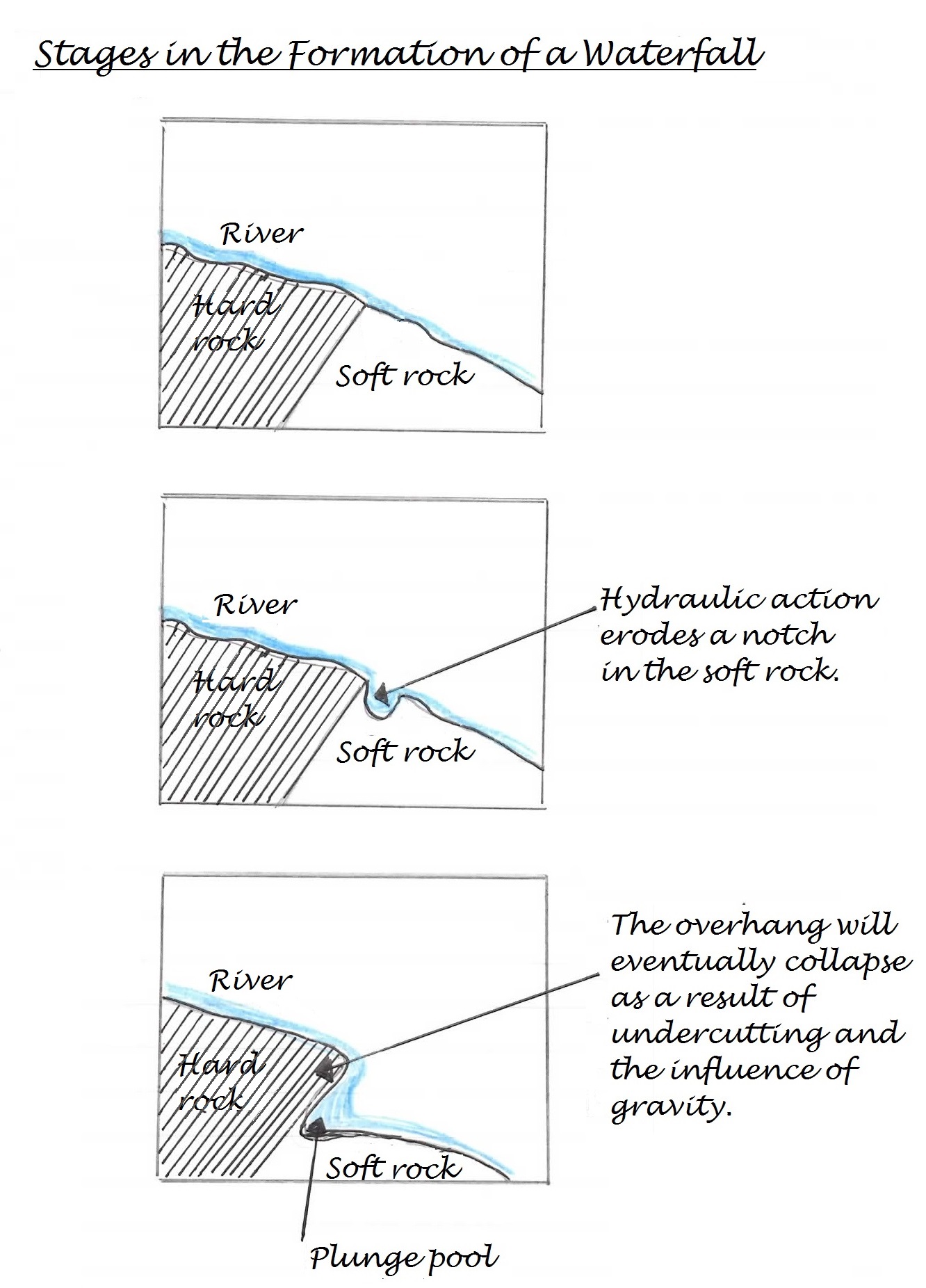
Question
- Leaving Certificate Geography (Higher) 2020: Part Two Q2 A–C
- Back to the question >
Answer
2 B (i)
This answer will discuss the processes involved in the formation of a waterfall. Waterfalls are formed as a result of river erosion in the upper course of a river. An example of a waterfall is Powerscourt Waterfall, County Wicklow.
A waterfall is a sudden drop in the river bed, causing the river to cascade over the edge. A waterfall is formed as a result of vertical erosion of the river bed by the processes of hydraulic action, abrasion, attrition and solution. A waterfall occurs most commonly where a band of hard rock lies across the river bed preventing the river from achieving a graded profile. An example of a hard rock is granite. Different types of rock are eroded at different rates, which is called differential erosion. Hydraulic action is the force of the moving water as it flows on the bed and banks of the river. As a result of hydraulic action, the less resistant soft bedrock downstream from the band of hard rock is eroded more quickly than the hard rock and gradually a small fall develops. Abrasion is where the river uses its load of pebbles, rocks and boulders to hit against the bed. Abrasion combines with hydraulic action to erode the soft rock and to deepen the fall. A plunge pool forms at the base of the waterfall and the water moves in a swirling action, called eddying. This causes abrasion and enlarges the plunge pool. Water splashes against the back wall of the waterfall and erodes it by the process of solution as the water dissolves the soft rock. This helps to weaken and break up the rock. Eventually the overhanging piece of hard rock collapses and slowly the waterfall retreats upstream. This is called headward erosion and can result in the formation of a gorge.