
Question
- Junior Cycle Science (Common Level) 2022: Q11
- Back to the question >
Answer
(a) Position C
(b) Position A — the northern hemisphere is tilted towards the sun.
(c) Position B or D. (In the northern hemisphere there are two equinox dates, one in March (spring equinox) and one in September (autumn equinox), so there are two options here for this answer.)
(d) The tilted Earth moves around the Sun.
(e) Instrument: A metre stick
(f) Variable: The students need to use the same pole when measuring each shadow.
(g) Group A carried out the better investigation as the metre stick’s height will not vary. A student’s height could vary in investigation B.
(h)
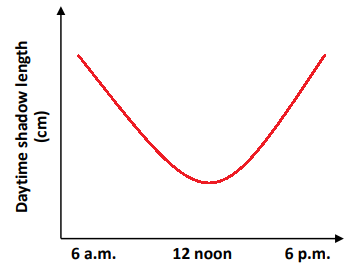
The graph shows that the length of the shadow is greatest in the morning and evening time when the Sun’s light is hitting the pole from a lower angle in the sky.
The graph also shows that the length of the shadow is at its lowest at midday when the Sun is striking the pole from the highest point in the sky, directly above the pole, generating very little, if any, shadow.